
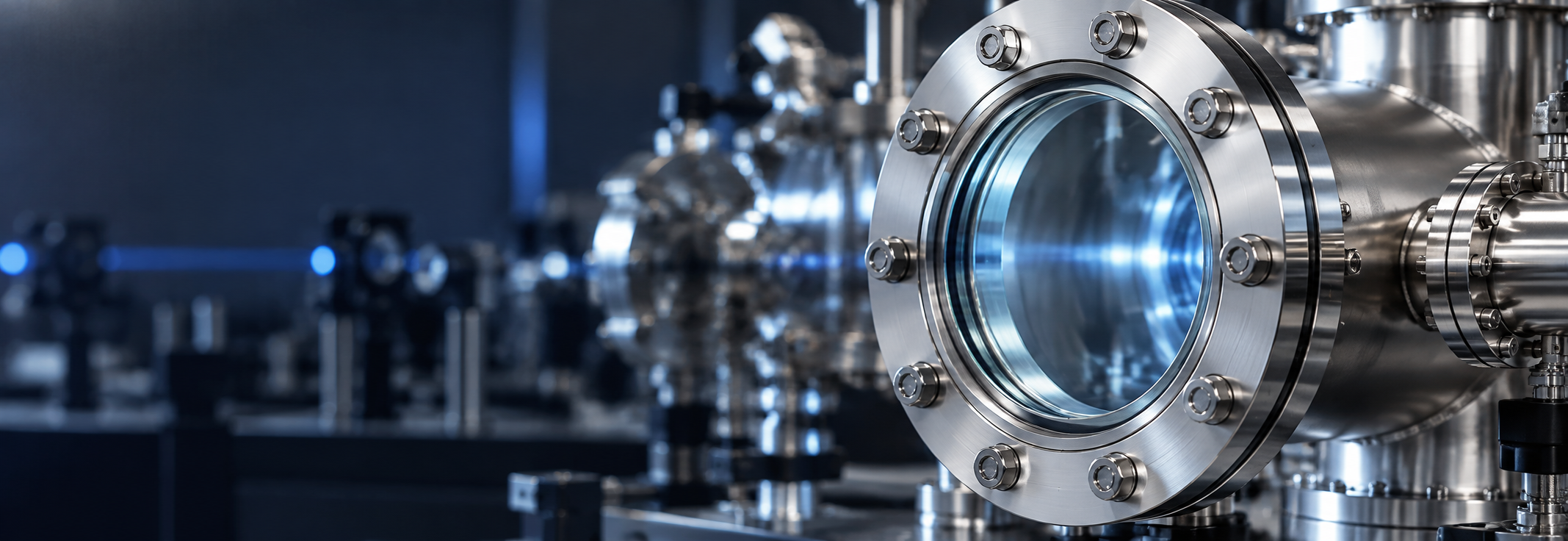
Vacuum Viewports
Vacuum viewports are specialized windows or ports integrated into vacuum systems, allowing visual observation or the transmission of light into or out of a vacuum chamber without compromising the vacuum environment. Firebird Optics offers viewports made from glass, fused silica, sapphire, ZnSe, CVD diamond and many more as well as a variety of flanges. All setups are designed to withstand the vacuum pressure and maintain optical clarity. They are sealed with high-quality, vacuum-compatible gaskets or welds to ensure they do not leak.
These viewports are essential in various fields, including materials science, semiconductor manufacturing, and fundamental physics research, where maintaining a controlled vacuum environment is crucial.
Kodial Viewports
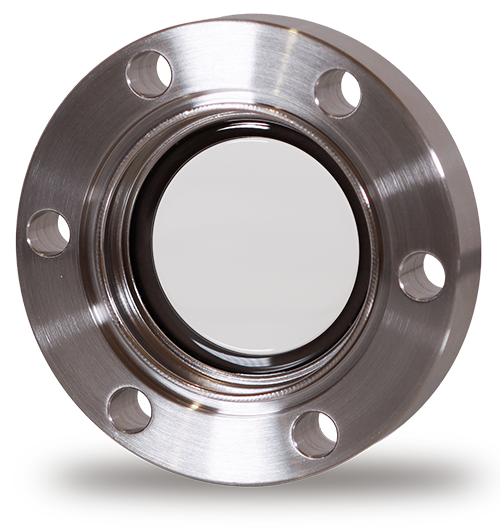

Kodial Viewports
Firebird Optics’ Kodial viewports are reliable and cost-effective solutions for vacuum systems requiring clear visual access and dependable performance. Made from high-quality borosilicate (Kodial 7056) glass, they offer excellent transmission across the visible to near-infrared spectrum, making them ideal for process monitoring and general observation. Their robust glass-to-metal seal, often utilizing a Kovar transition, ensures strong vacuum integrity and supports repeated bake-outs, with CF versions suitable for UHV conditions. Available in CF, KF, and ISO flange configurations, these viewports integrate easily into a wide range of systems and can be fully customized to customer specifications, including size, thickness, coatings, and mounting options for optimized performance.
Kodial Viewports for Vacuum Systems: Specifications, Applications, and Flange Selection Guide
Introduction
Kodial viewports are reliable, cost-effective optical windows designed for high vacuum (HV) and ultra-high vacuum (UHV) environments where clear visual access and system durability are essential. Manufactured from Kodial 7056 borosilicate glass, these viewports provide excellent optical transmission across the visible to near-infrared spectrum, making them ideal for monitoring, diagnostics, and general observation within vacuum chambers. Their robust glass-to-metal construction ensures long-term performance, even under repeated thermal cycling and demanding operating conditions.
Why Choose Kodial Viewports?
Kodial (borosilicate 7056) glass is widely used as a general-purpose viewport material due to its balance of optical performance and durability:
High Visible Transmission: Typically >90% transmission in the visible range, ideal for clear observation
Broad Spectral Range: Approx. 320 nm to 2.5 µm (visible to near-IR)
Low Thermal Expansion: Minimizes stress during heating and cooling cycles
Strong Mechanical Durability: Resistant to thermal shock and mechanical stress
Cost-Effective: Provides reliable performance at a lower cost compared to specialty optical materials
These properties make Kodial viewports an excellent choice for applications where clear visibility, durability, and affordability are key requirements.
Typical Specifications of Kodial Viewports
Firebird Optics’ Kodial viewports are designed to meet the demands of vacuum systems and optical observation. Typical specifications include:
Material: Kodial 7056 borosilicate glass
Transmission Range: ~320 nm to 2.5 µm (visible to near-IR)
Visible Transmission: >90% (uncoated)
Surface Quality: 60/40 or better depending on application
Leak Rate: ≤ 1 × 10⁻¹⁰ mbar·L/s (He)
Pressure Range: Atmosphere to UHV (~10⁻¹¹ mbar for CF designs)
Operating Temperature:
CF (UHV metal seal): up to ~350–400°C
KF/ISO (O-ring seal): up to ~150–200°C
Construction: Glass sealed to Kovar transition ring with stainless steel flange
Flange Materials: Stainless steel (304L, 316L/316LN)
Custom sizes, coatings (AR, ITO), and configurations are available to meet specific system requirements.
Applications of Kodial Viewports
Vacuum Chamber Observation
Kodial viewports are widely used for visual monitoring of processes inside vacuum chambers, including coating, deposition, and plasma systems.
Semiconductor & Thin Film Processing
They provide reliable optical access for process monitoring and diagnostics in semiconductor manufacturing and thin film deposition systems.
Research & Laboratory Systems
Ideal for general-purpose laboratory vacuum setups, where frequent observation and system flexibility are required.
Optical Monitoring & Measurement
Kodial viewports can be used to observe emissions, monitor reactions, and enable optical measurements within vacuum environments.
Industrial Vacuum Systems
Used in industrial processing systems where durability and cost efficiency are important without requiring specialized optical materials.
Flange Options: CF vs KF vs ISO
Selecting the correct flange type is essential for ensuring compatibility with your vacuum system. Kodial viewports are available in CF, KF, and ISO configurations, each suited to different applications.
CF (ConFlat) Flanges – For Ultra-High Vacuum (UHV)
Seal Type: Metal-to-metal seal using copper gasket
Vacuum Range: UHV (down to ~10⁻¹¹ mbar)
Temperature Capability: Highest bake-out temperatures (~350–400°C)
Best Applications:
Semiconductor fabrication
Surface science and UHV research
Permanent vacuum installations
Why choose CF?
CF flanges provide the most reliable, leak-tight seal and are ideal for long-term, high-temperature UHV applications.
KF (Quick Flange) – For Flexible Vacuum Systems
Seal Type: Elastomer O-ring with clamp
Vacuum Range: Rough to high vacuum
Temperature Capability: Moderate (~150°C)
Best Applications:
Laboratory setups
R&D systems
Systems requiring frequent assembly/disassembly
Why choose KF?
KF flanges allow for quick installation and removal, making them ideal for modular and experimental setups.
ISO Flanges – For Large Vacuum Systems
Seal Type: O-ring or bolted flange system
Vacuum Range: High vacuum
Temperature Capability: Moderate (~150–200°C)
Best Applications:
Large vacuum chambers
Industrial processing systems
Applications requiring larger viewing areas
Why choose ISO?
ISO flanges are designed for large-scale systems, providing strong mechanical support and scalability.
Custom Kodial Viewports
Firebird Optics offers fully customizable Kodial viewports tailored to specific application requirements, including:
Custom diameters and thicknesses
Anti-reflective (AR) or conductive (ITO) coatings
Specialized flange materials and configurations
Integration into complex vacuum assemblies
Customization ensures optimal performance for a wide range of scientific, industrial, and research applications.
| Flange Type | Flange OD | View Diameter | Optic Thickness | Max Temperature |
|---|---|---|---|---|
| CF Flange Kodial Viewports | ||||
| NW16CF | 34 mm / 1.33" | 15 mm / 0.60" | 1.0 mm / 0.04" | 350°C |
| NW35CF | 70 mm / 2.75" | 32 mm / 1.26" | 2.5 mm / 0.10" | 350°C |
| NW35CF Large Area | 70 mm / 2.75" | 38 mm / 1.50" | 3.25 mm / 0.13" | 350°C |
| NW63CF | 114 mm / 4.50" | 63 mm / 2.49" | 3.0 mm / 0.12" | 350°C |
| NW100CF | 152 mm / 6.00" | 89 mm / 3.51" | 4.0 mm / 0.16" | 350°C |
| NW150CF | 203 mm / 8.00" | 136 mm / 5.36" | 6.5 mm / 0.26" | 350°C |
| NW200CF | 254 mm / 10.00" | 136 mm / 5.36" | 6.5 mm / 0.26" | 350°C |
| KF Flange Kodial Viewports | ||||
| KF16 | 30 mm / 1.20" | 15 mm / 0.60" | 1.0 mm / 0.04" | 150°C |
| KF25 | 40 mm / 1.60" | 15.5 mm / 0.62" | 1.5 mm / 0.06" | 150°C |
| KF40 | 55 mm / 2.20" | 32 mm / 1.26" | 2.5 mm / 0.10" | 150°C |
| KF40 Large Area | 55 mm / 2.20" | 38 mm / 1.50" | 3.25 mm / 0.13" | 150°C |
| KF50 | 75 mm / 3.00" | 38 mm / 1.50" | 3.25 mm / 0.13" | 150°C |
| ISO Flange Kodial Viewports | ||||
| ISO63 | 95 mm / 3.80" | 38 mm / 1.50" | 3.25 mm / 0.13" | 150°C |
| ISO100 | 130 mm / 5.20" | 63 mm / 2.49" | 3.0 mm / 0.12" | 150°C |
| ISO160 | 180 mm / 7.10" | 89 mm / 3.51" | 4.0 mm / 0.16" | 150°C |