

Vacuum Viewports
Vacuum viewports are specialized windows or ports integrated into vacuum systems, allowing visual observation or the transmission of light into or out of a vacuum chamber without compromising the vacuum environment. Firebird Optics offers viewports made from glass, fused silica, sapphire, ZnSe, CVD diamond and many more as well as a variety of flanges. All setups are designed to withstand the vacuum pressure and maintain optical clarity. They are sealed with high-quality, vacuum-compatible gaskets or welds to ensure they do not leak.
These viewports are essential in various fields, including materials science, semiconductor manufacturing, and fundamental physics research, where maintaining a controlled vacuum environment is crucial.
Germanium (Ge) Viewports
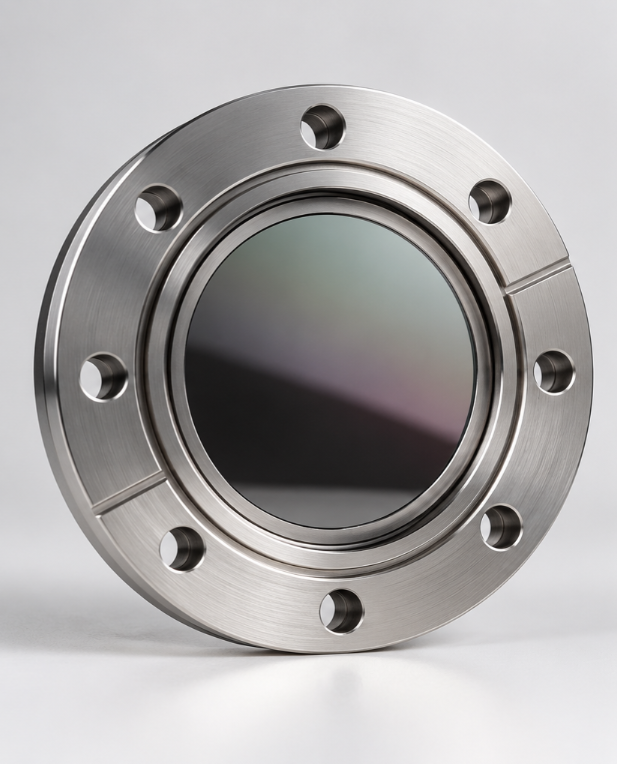
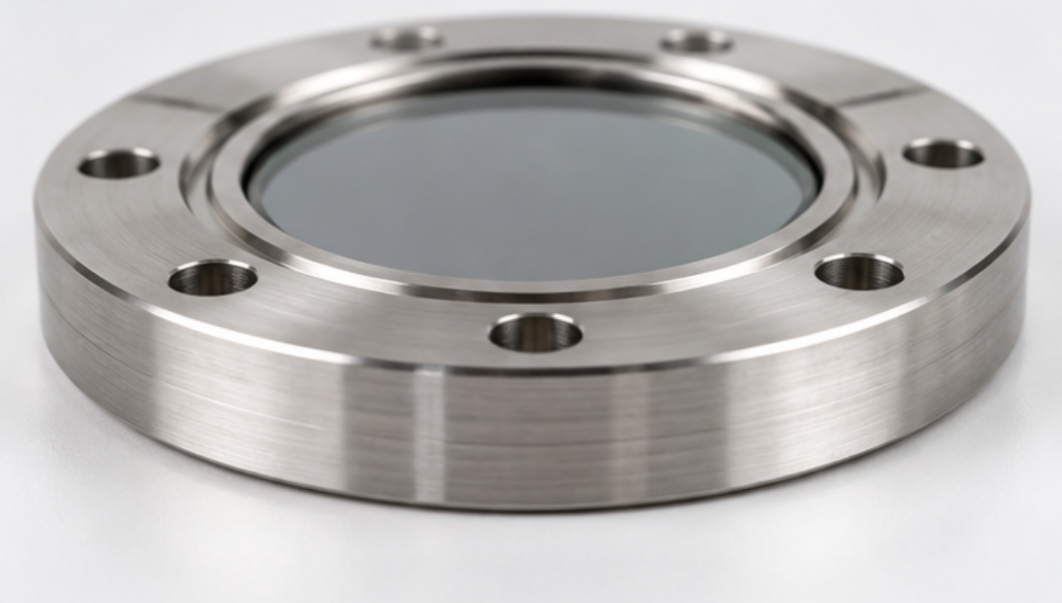
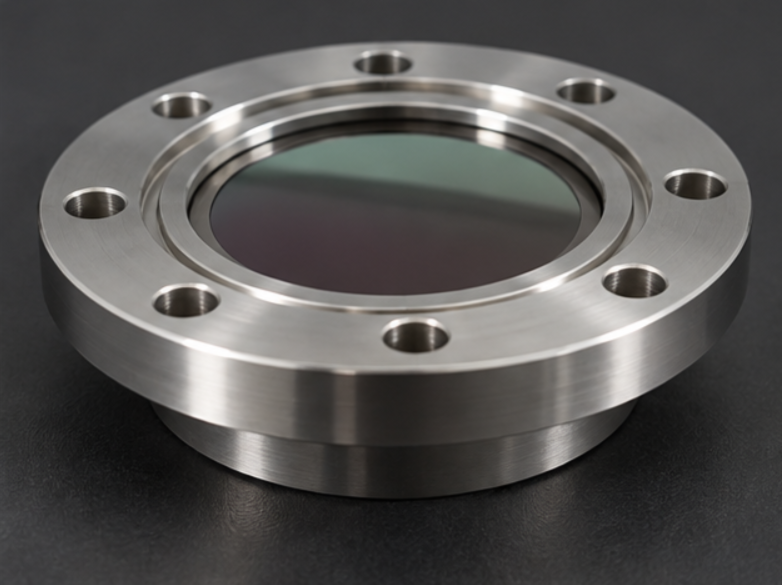
Germanium (Ge) Viewports
Firebird Optics’ Germanium (Ge) viewports are designed for high-performance vacuum applications requiring reliable infrared transmission. With excellent transmission across the mid-wave and long-wave infrared spectrum, germanium is an ideal viewport material for thermal imaging, IR spectroscopy, infrared sensing, and other applications where optical access to a vacuum chamber is required.
Germanium is opaque throughout the visible spectrum and transmits approximately from 2–16 µm, making it particularly well suited for systems designed exclusively around infrared wavelengths. Its durability and resistance to air, water, alkalis, and many acids also provide dependable performance in demanding vacuum environments.
Available in CF, KF, and ISO flange configurations, Firebird Optics’ germanium viewports can be customized to meet specific system requirements, including viewport size, thickness, flange configuration, and anti-reflective coatings. Custom AR coatings can also be applied to reduce reflection losses and increase transmission across targeted infrared wavelength ranges.
Germanium Viewport: Where Infrared Optical Access Meets the Demands of Vacuum
Getting infrared light into or out of a vacuum chamber presents a unique engineering challenge. The optical material needs to transmit the wavelengths your system depends on, while the complete assembly must provide reliable optical access without compromising the vacuum environment.
For mid-wave and long-wave infrared applications, a Germanium Viewport provides an effective solution by combining the infrared properties of germanium with a vacuum-compatible flange assembly.
Germanium has long been used throughout infrared optics because of its broad IR transmission range, high refractive index, mechanical properties, and resistance to many environmental conditions. Firebird Optics brings those characteristics into a ready-to-integrate viewport designed for research, industrial, analytical, and infrared systems.
Why Germanium for a Vacuum Viewport?
Germanium, or Ge, is an infrared optical material with useful transmission from approximately 2 to 16 µm. Unlike many conventional optical materials, germanium is opaque throughout the visible spectrum. That combination makes it particularly useful when an optical system needs infrared transmission without visible-light transmission.
Germanium is also inert to air, water, alkalis, and many acids, providing a durable optical surface for demanding applications. Its relatively low dispersion has also made germanium a common material for infrared imaging and lower-power CO2 laser applications.
There is one important consideration. Germanium has a high refractive index, approximately 4 across much of its useful infrared range. Uncoated germanium therefore experiences significant reflection losses at its surfaces.
This is where optical coatings become particularly valuable. A properly designed anti-reflective coating can reduce surface reflections and improve transmission over a specified wavelength range.
Firebird Optics Germanium Viewport Specifications
Firebird Optics Germanium Viewports combine a precision germanium optical window with a vacuum flange for straightforward integration into vacuum systems.
Our Germanium Viewports are available in CF, KF, and ISO flange configurations, allowing engineers to select an assembly that fits their existing vacuum hardware. Viewport size, germanium thickness, flange configuration, and optical coating can also be customized for application-specific requirements.
The germanium itself offers a useful wavelength range of approximately 2–16 µm. Firebird's standard germanium optics have a surface quality of 60/40, with custom configurations and coatings available.
For systems where transmission efficiency is especially important, Firebird Optics can provide custom anti-reflective coatings designed around targeted infrared wavelength ranges. This allows the optical performance of the viewport to be matched more closely to the detector, source, laser, or instrument operating behind it.
Key Germanium Properties
These material characteristics help explain why germanium remains an important optical material even as the availability and cost of the raw material have become increasingly challenging.
Germanium Viewport Applications
The combination of vacuum compatibility and infrared transmission opens the door to applications where standard visible-light viewports simply cannot provide the necessary spectral performance.
Infrared spectroscopy is one natural fit. A Germanium Viewport can provide an optical interface between an infrared source or detector and a sample or process contained within a vacuum chamber. Germanium's broad infrared transmission range makes it useful for systems working across portions of both the mid-wave and long-wave IR spectrum.
Thermal imaging and IR sensing are other potential applications. Germanium is widely used in thermal cameras, infrared sensors, and related imaging equipment because of its infrared transmission characteristics. A germanium viewport can extend those capabilities to applications where the object, process, or experiment must remain under vacuum.
Vacuum research and laboratory instrumentation may also require infrared optical access for monitoring experiments, analyzing materials, collecting spectral information, or introducing infrared energy into a chamber.
Germanium can also be useful for lower-power CO2 laser systems, although the suitability of a specific viewport, coating, and optical configuration should always be evaluated against the laser wavelength, power, beam diameter, and operating conditions.
Other potential uses include materials research, gas analysis, semiconductor processing, environmental testing, detector development, and other vacuum systems requiring an IR-transparent optical interface.
The Germanium Supply Chain Has Become Complicated
The optical properties that make germanium valuable are only one side of the story. Germanium is also a critical material used across fiber optics, infrared optics, semiconductors, solar cells, and radiation detectors. That demand intersects with a highly concentrated global supply chain.
China has historically played a major role in global germanium production and exports. In August 2023, the Chinese government implemented export licensing requirements for germanium products. These restrictions contributed to greater uncertainty surrounding global availability, lead times, and pricing.
The situation became considerably more restrictive in December 2024, when China announced additional restrictions affecting germanium exports to the United States.
These developments arrived in a germanium market that was already relatively small and concentrated. Unlike more widely traded industrial materials, germanium production and availability can be difficult to predict, particularly when geopolitical restrictions are added to existing supply constraints.
Prices have responded accordingly. During 2024, reported European pricing for high-purity germanium metal increased substantially, reflecting the tightening supply environment.
That does not mean germanium has disappeared from the market. Production, processing, recycling, and efforts to develop alternative sources continue outside China. Governments and private industry have also increased their focus on establishing more diversified germanium supply chains.
It does mean, however, that germanium sourcing requires more attention than it once did.
Why Supply Matters When Specifying a Germanium Viewport
For engineers and procurement teams, the germanium supply chain has practical consequences.
Availability, raw-material costs, optic dimensions, coating requirements, and lead times can all influence a project. Large-diameter or highly customized germanium optics can be particularly sensitive to material availability because more usable optical-grade material is required for each component.
Planning ahead becomes important when specifying custom Germanium Viewports, particularly for production programs requiring repeat quantities.
It also makes the initial optical specification more important. Rather than over-specifying a component, engineers can work from the actual wavelength range, clear aperture, flange configuration, vacuum requirements, and coating performance their system needs.
Specifying the Right Germanium Viewport
A Germanium Viewport fills a specialized but increasingly important role. It creates an optical pathway into a vacuum system while taking advantage of germanium's excellent mid-IR and long-wave IR performance.
When selecting a viewport, consider the operating wavelength, clear aperture, flange type, germanium thickness, coating requirements, vacuum conditions, and expected optical power. These factors can significantly affect both performance and cost.
Firebird Optics offers Germanium Viewports in CF, KF, and ISO configurations, with custom germanium dimensions and optical coatings available for application-specific requirements.
If your system requires infrared optical access to a vacuum chamber, contact Firebird Optics to discuss your Germanium Viewport requirements and current material availability.