

Optical Windows
Optical windows are transparent components made of materials like glass or crystal that are used to protect and control the flow of light in optical systems. IR windows and optics for use in FTIR Spectroscopy and CO2 lasers. This includes discs, rectangular plates and various other geometries.
In various fields, optical windows serve many purposes. They act as protective barriers, shielding sensitive optical components from environmental factors such as dust, moisture, and contaminants. Additionally, they enable the transmission of light while minimizing distortion, reflection, and absorption, thus maintaining the integrity of the optical system.
Optical windows are employed in a wide range of applications, including scientific research, industrial manufacturing, aerospace, defense, and telecommunications. They are utilized in optical instruments like cameras, microscopes, telescopes, lasers, and sensors. By providing a stable optical interface, optical windows facilitate accurate measurements, imaging, and analysis of light, enabling advancements in numerous fields.
Optical windows come in many shapes and sizes but a major factor is their material. The types of materials that an optical window is constructed from dictate the wavelengths (measured in nm) that they can view. In IR It is extremely important that selecting the right material is done to avoid many a headache and a waste of money and time.
If you are having choice fatigue and are getting overwhelmed by all the options please check out our optical window guide.
Strontium Fluoride (SrF2) Windows
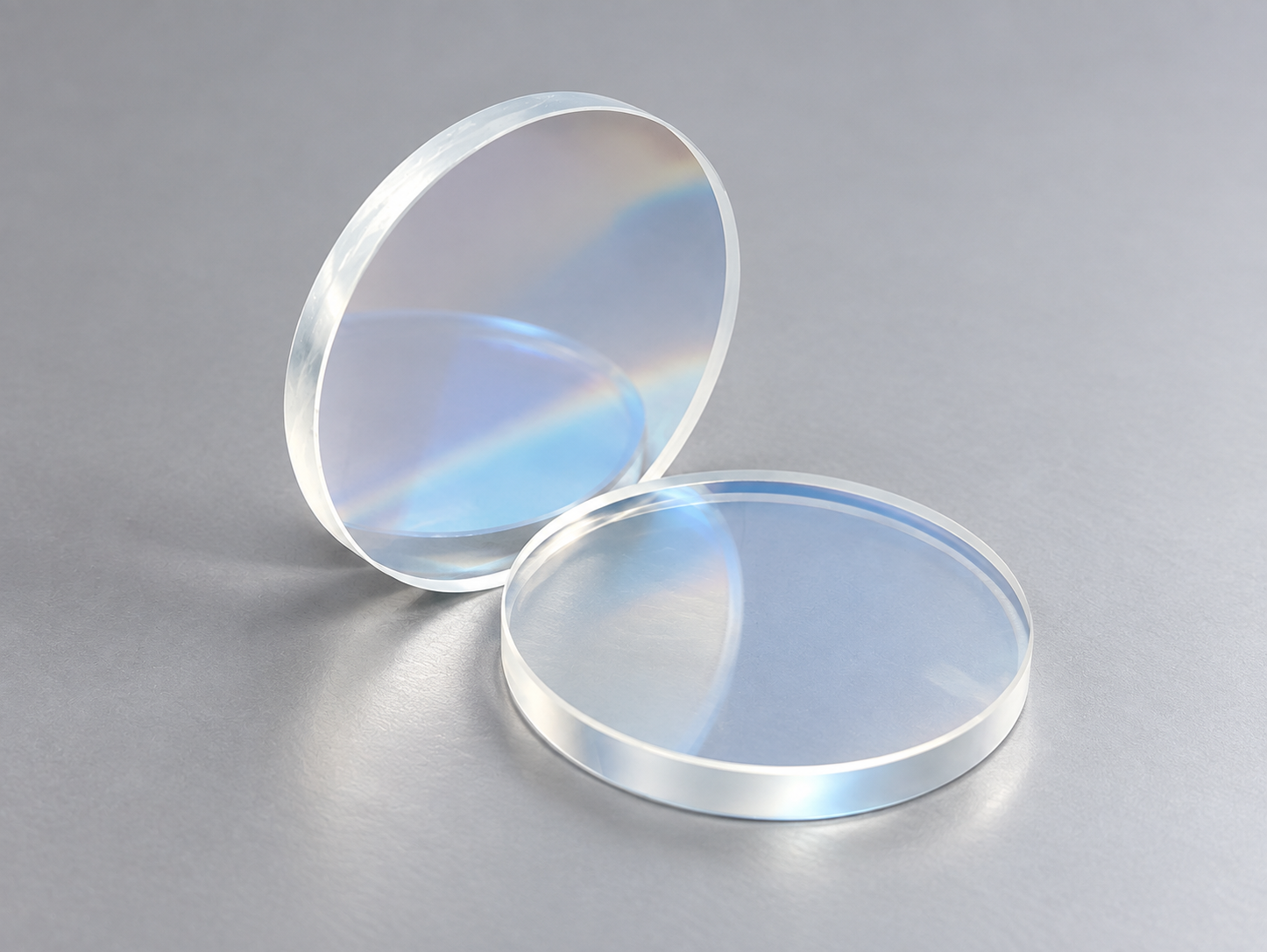
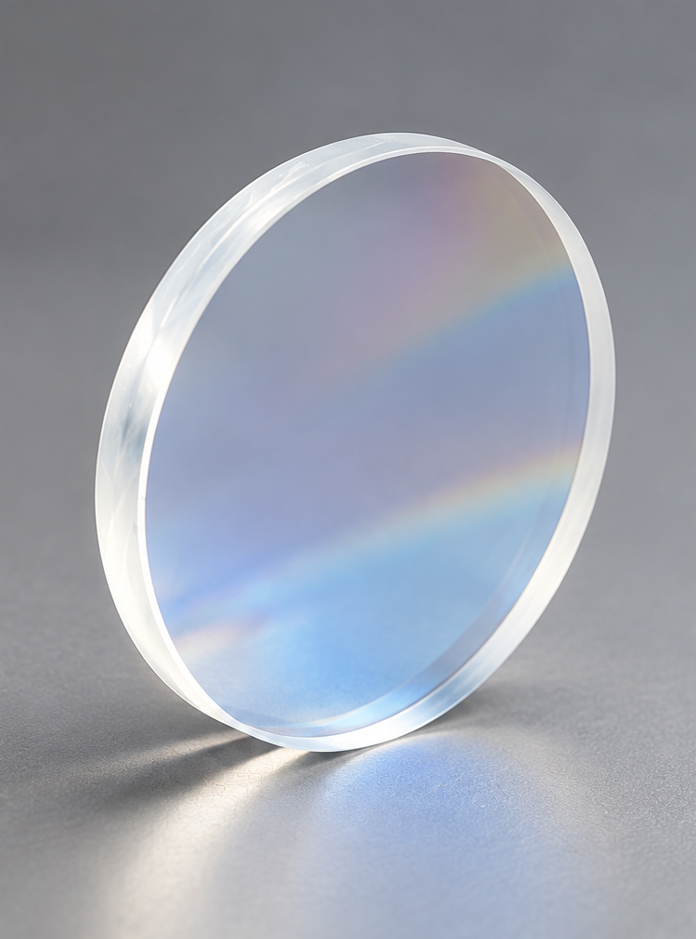
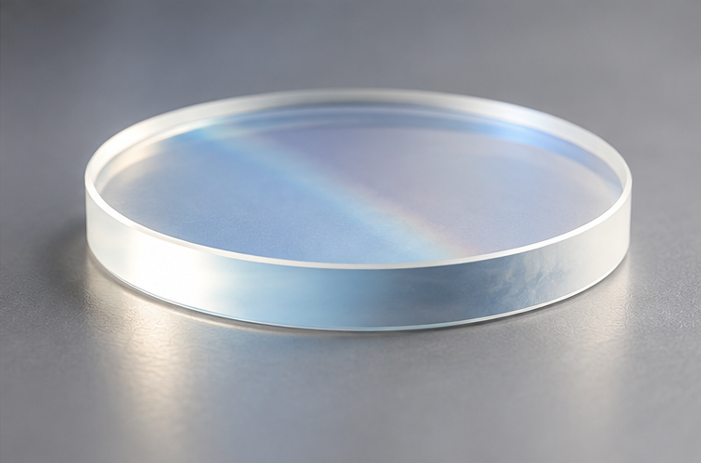
Strontium Fluoride (SrF2) Windows
Strontium Fluoride (SrF₂) windows are specialty optical components offering broad transmission from approximately 0.15 to 11 µm, covering wavelengths from the ultraviolet through the visible and into the infrared. Optically, SrF₂ provides properties intermediate between Calcium Fluoride (CaF₂) and Barium Fluoride (BaF₂), making it a useful alternative for specialized UV, VIS, and IR optical systems.
With a refractive index of approximately 1.439 at 0.55 µm, low absorption in the infrared, and a melting point of approximately 1450°C, Strontium Fluoride can be used in applications including spectroscopy, infrared instrumentation, research systems, and other optical assemblies requiring broad spectral transmission.
Firebird Optics offers Strontium Fluoride Windows for specialized optical applications, with custom sizes, thicknesses, and configurations available to meet your system requirements. Contact Firebird Optics for custom SrF₂ optics or help determining whether Strontium Fluoride is the right material for your application.
Strontium Fluoride Windows: Broad UV to IR Transmission for Specialized Optical Systems
When an optical system requires transmission across a wide spectral range, material selection becomes an important part of the design. Strontium Fluoride windows, commonly referred to as SrF₂ windows, provide broad optical transmission from the ultraviolet through the visible and well into the infrared.
Firebird Optics offers Strontium Fluoride windows for research, spectroscopy, infrared instrumentation, analytical equipment, and other specialized optical systems. Custom dimensions and configurations can be produced to meet application-specific requirements.
What Is a Strontium Fluoride Window?
Strontium Fluoride, or SrF₂, is a crystalline optical material with properties that fall between Calcium Fluoride (CaF₂) and Barium Fluoride (BaF₂). This combination makes SrF₂ an interesting option for optical systems where more commonly used fluoride materials may not provide the desired balance of optical and physical characteristics.
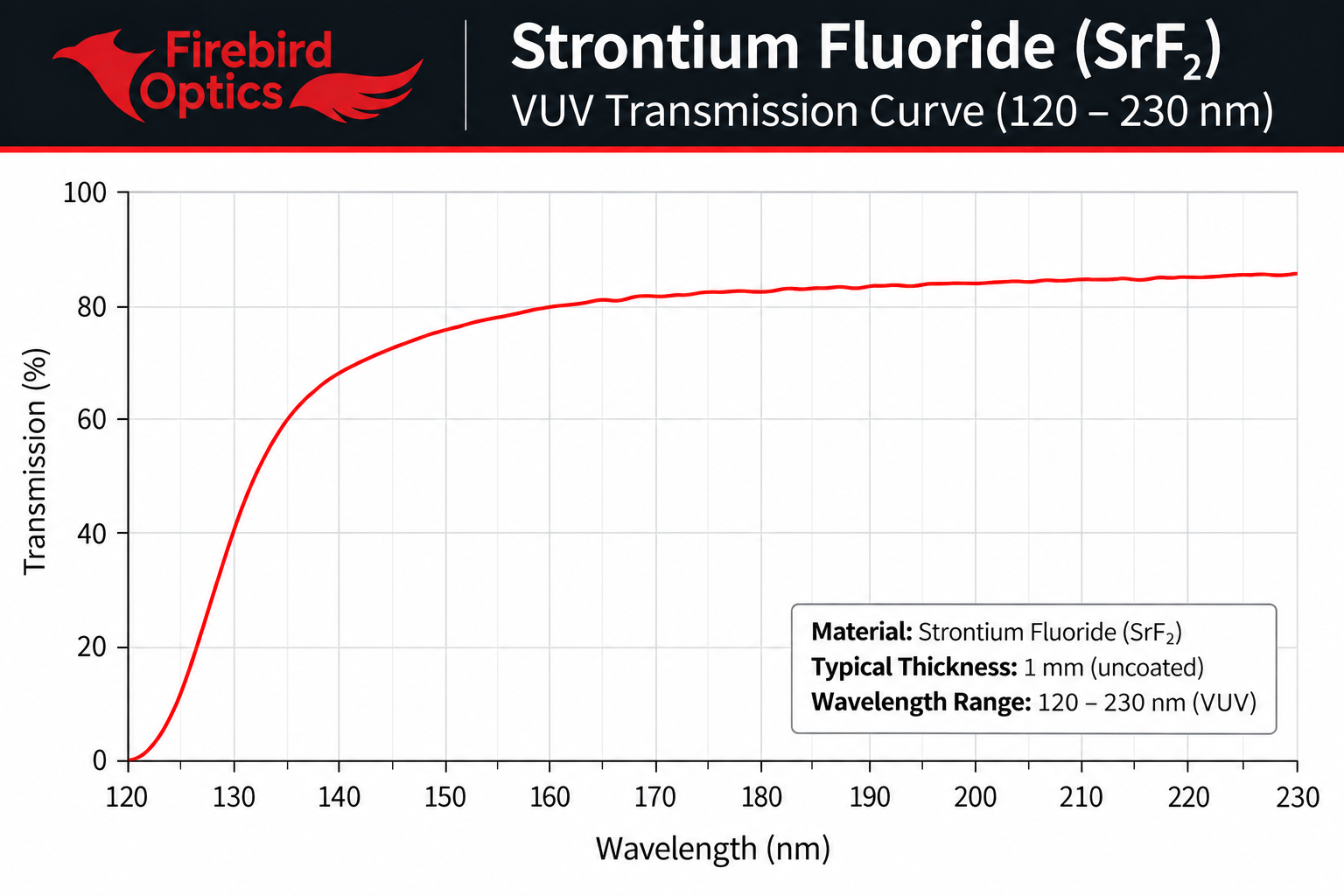
One of the most notable characteristics of Strontium Fluoride is its exceptionally broad spectral range. SrF₂ transmits from approximately 0.15 to 11 µm, allowing a single optical material to operate across UV, visible, near-infrared, and portions of the mid-infrared spectrum.
For engineers working with multispectral instruments or specialized optical assemblies, that broad transmission range can make Strontium Fluoride windows particularly useful.
Optical Properties of Strontium Fluoride
In addition to broad spectral transmission, SrF₂ offers a relatively low refractive index. The refractive index is approximately 1.439 at 0.55 µm, with a reflection loss of approximately 6.3% at 0.55 µm across two uncoated surfaces.
Strontium Fluoride also has an absorption coefficient of less than 1 × 10⁻³ cm⁻¹ at 5 µm, supporting its use in infrared optical applications.
Key material properties include:
PropertyStrontium Fluoride (SrF₂)Transmission RangeApprox. 0.15–11 µmRefractive Index1.439 at 0.55 µmDensity4.24 g/cm³Melting Point1450°CThermal Conductivity8.3 W/m·K at 293 KThermal Expansion18.4 × 10⁻⁶/°C at 293 KYoung's Modulus89.1 GPaPoisson Ratio0.25Molecular Weight125.62
These properties position SrF₂ as a specialized optical material for applications requiring performance beyond the visible spectrum.
Why Choose Strontium Fluoride Windows?
The primary advantage of a Strontium Fluoride window is spectral versatility. Many optical window materials perform well within a specific wavelength region. SrF₂ offers useful transmission across a much broader range.
This makes it worth considering when a system needs to operate at multiple wavelengths or when engineers need an optical window capable of transmitting UV, visible, and infrared radiation.
SrF₂ can also serve as an alternative when comparing fluoride crystal materials. Its optical and physical characteristics are generally positioned between those of Calcium Fluoride and Barium Fluoride.
Applications for Strontium Fluoride Windows
Because SrF₂ is a specialty material, Strontium Fluoride windows are generally selected for applications with specific spectral or material requirements rather than as a general-purpose window.
Potential applications include UV and infrared spectroscopy, analytical instrumentation, optical research, multispectral systems, infrared instrumentation, laboratory equipment, and specialized imaging systems.
Spectroscopy is particularly relevant because the broad transmission range allows SrF₂ to support optical systems operating across multiple spectral regions. Research and analytical instruments can similarly benefit when a single optical window must provide transmission beyond the capabilities of conventional optical glass.
Strontium Fluoride vs. Calcium Fluoride and Barium Fluoride
Calcium Fluoride, Strontium Fluoride, and Barium Fluoride belong to the same general family of fluoride optical crystals, but they should not be considered interchangeable.
Calcium Fluoride (CaF₂) is widely used for UV, visible, and infrared optics. Barium Fluoride (BaF₂) extends farther into the infrared and is selected for certain specialized IR applications. Strontium Fluoride (SrF₂) occupies an intermediate position between these materials in several optical and physical characteristics.
The right material ultimately depends on factors such as operating wavelength, environmental conditions, window dimensions, mechanical requirements, and the overall optical design.
For applications where CaF₂ or BaF₂ is being considered, SrF₂ may therefore be another material worth evaluating rather than automatically defaulting to the more commonly specified fluoride crystals.
Custom Strontium Fluoride Windows from Firebird Optics
Every optical system has different requirements. Diameter, thickness, surface specifications, and other dimensional requirements can influence how an optical window performs once integrated into an instrument or assembly.
Firebird Optics offers Strontium Fluoride windows for specialized UV, visible, and infrared optical applications, including custom configurations for systems that require dimensions outside standard optical window formats.
When requesting a custom SrF₂ window, providing the operating wavelength, required diameter or dimensions, thickness, surface quality, and quantity can help determine an appropriate configuration.
Selecting the Right SrF₂ Window for Your Application
Strontium Fluoride is not necessarily the first material engineers encounter when designing an optical system, but its combination of broad transmission and useful optical characteristics gives it a distinct place among fluoride crystals.
With transmission extending from approximately 0.15 to 11 µm, a Strontium Fluoride window can provide optical access across an unusually broad portion of the spectrum.
For spectroscopy, research instrumentation, infrared systems, or other specialized applications, Firebird Optics can help supply Strontium Fluoride windows manufactured around your optical and dimensional requirements.
Contact Firebird Optics to discuss your Strontium Fluoride window specifications, custom sizes, quantities, or application requirements.
| Material Property | Specification |
|---|---|
| Transmission Range | 0.15–11 µm |
| Refractive Index | 1.439 at 0.55 µm |
| Reflection Loss | 6.3% at 0.55 µm (2 surfaces) |
| Absorption Coefficient | <1 × 10⁻³ cm-1 at 5 µm |
| Reststrahlen Peak | 46 µm |
| dn/dT | -12 × 10-6 K-1 |
| Density | 4.24 g/cm³ |
| Melting Point | 1450°C |
| Thermal Conductivity | 8.3 W·m-1·K-1 at 293 K |
| Thermal Expansion | 18.4 × 10⁻⁶/°C at 293 K |
| Knoop Hardness | 154 (100) & 140 (110) |
| Specific Heat Capacity | 543 J·kg-1·K-1 |
| Dielectric Constant | 7.69 at 2 MHz |
| Young's Modulus | 89.1 GPa |
| Shear Modulus | 34.6 GPa |
| Bulk Modulus | 24.65 GPa |
| Apparent Elastic Limit | 36.5 MPa (5,300 psi) |
| Poisson Ratio | 0.25 |
| Solubility | 0.012 g/100 g water at 27°C |
| Molecular Weight | 125.62 |
| Crystal Structure | Cubic Fm3m (#225), cleaves on (111) |

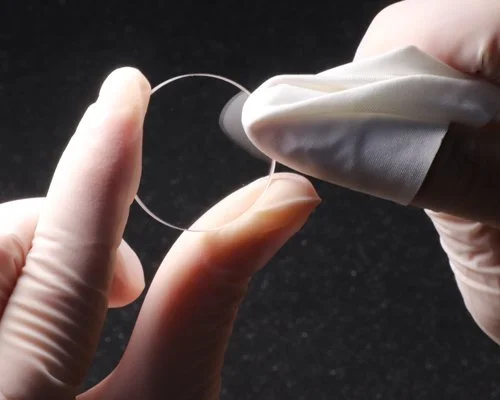



Finding the right optical window can be an exercise in choice fatigue. Let us help!